Summary
The March Core Update 2026 has officially completed its rollout, marking a critical moment for brands evaluating their search performance. As Google’s first 2026 core update, it has reshaped rankings across industries, highlighting a clear shift in how content is evaluated and surfaced.
Key Takeaways
- The Google March 2026 core update has fully rolled out after ~2 weeks.
- Ranking volatility has now stabilized, revealing true winners and losers.
- This update reinforces Google’s existing quality signals, and not new rules.
- Sites experienced re-ranking, and not penalties.
- Post-update performance now reflects long-term content positioning.
Table of Contents
- A few facts about the Google March Core Update
- The Real Impact on Rankings
- What Brands & Marketers Should Do Next?
- Conclusion
- FAQs
With the March Core Update rollout now complete, brands and marketers finally have a clear view of where they stand.
During the rollout phase, ranking volatility often clouds judgment. But once the update settles, search visibility reflects something far more important: Google’s updated assessment of content relevance and usefulness.
For businesses investing in digital marketing services and/or AI marketing services, this shift directly impacts how performance, visibility, & ROI are measured in search.
A few facts about the Google March Core Update
- The first core update of 2026 has completed its rollout.
- The update took 12 days and 4 hours, from 27th March 2026 to 8th Apr 2026.
- This is the third update this year, following the February Discover update and the March Spam update.
- Google did not launch any specific guidelines for this core update.
The Real Impact on Rankings
Only when you know how the Google March Core update impacted search rankings can you optimize your content accordingly, whether you own a brand or a digital marketing agency.
1. Rankings Have Been Rebalanced, Not Penalized
The March core update 2026 did not introduce penalties; it rebalanced rankings.
This means:
- Some sites’ rankings dropped because others’ rankings improved in relative value.
- Visibility changes reflect comparative usefulness, not violations.
For brands, this distinction is crucial. Recovery is not about fixing errors; it’s about becoming more competitive in content value.
2. Post-Rollout Data Reveals Clear Winners
Now that the update has settled, patterns are easier to identify:
- Sites with strong topical consistency gained traction.
- Pages offering clear & structured answers performed better.
- Brands with recognizable authority signals saw improved stability.
This indicates that Google is refining how it compares content within a topic cluster rather than evaluating pages in isolation.
3. Content Differentiation Is Now a Deciding Factor
One of the clearest outcomes of the update is the importance of distinctiveness.
Websites relying on:
- Repetitive topic coverage,
- Lightly reworked information, and
- High-volume & low-differentiation strategies have struggled to maintain their rankings.
In contrast, content that offers unique angles, clearer explanations, or stronger context is gaining visibility.
4. Volatility Has Given Way to Stability
What was clearly seen during and post-rollout is that search volatility has given way to ranking stability.
During the rollout:
- Rankings fluctuated frequently.
- Traffic patterns were inconsistent.
Now:
- Positions are stabilizing.
- Trends are becoming reliable.
In short, this is the ideal time for marketers to:
- Conduct performance analysis,
- Identify impacted pages, and
- Make informed strategic decisions.
5. Signals Are Being Reinforced, Not Rewritten
Rather than introducing entirely new ranking factors, this update appears to strengthen existing evaluation systems.
In a nutshell, as part of ongoing Google Search’s Core Updates, this update reinforces the importance of long-term quality alignment over short-term tactics.
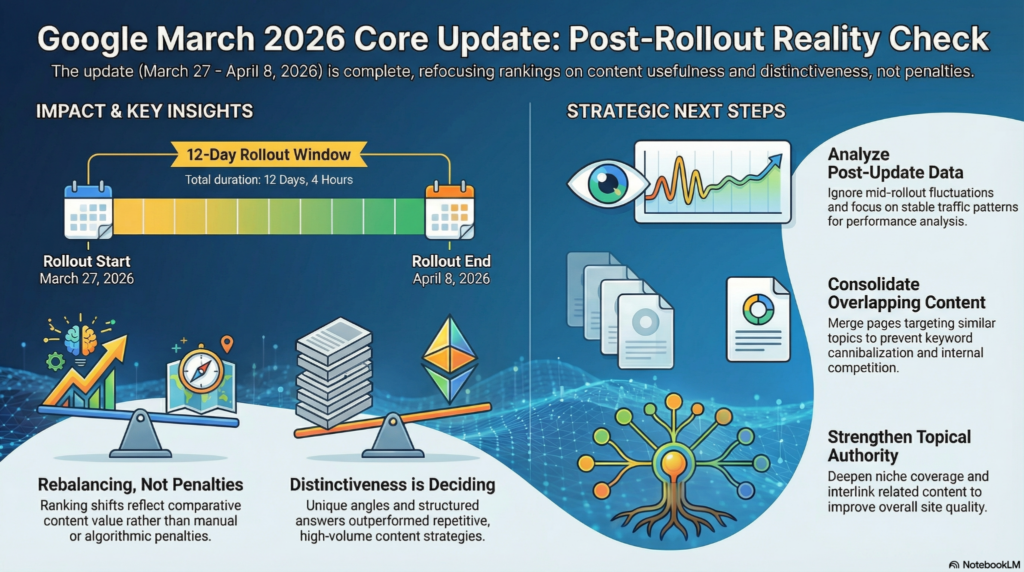
Google March Core Update: Post-rollout Reality
What Brands & Marketers Should Do Next?
Now that you know what changed, it’s time to take the necessary actions. We’ve listed 5 key action items for brands & marketers across India.
1. Analyze Post-Update Performance (Not Mid-Rollout Data)
Focus only on:
- Pre-update vs current rankings
- Stable traffic patterns
And avoid decisions based on temporary fluctuations.
2. Improve Content Competitiveness
Instead of just updating content:
- Make it more useful than competing pages.
- Add clarity, examples, and a stronger structure.
PS: Make it worthy of the first position in SERP and AI search results.
3. Consolidate Overlapping Content
If multiple pages target similar topics:
- Merge or differentiate them, and
- Avoid internal competition.
Because keyword cannibalization is real, and it prevents your content marketing efforts from showing the desired results.
4. Strengthen Topical Authority
Build depth in key areas by:
- Expanding coverage within a niche, and
- Interlinking related content.
Because a smooth-flowing user thought process will result in smoother website navigation and quicker & heightened conversions.
5. Take a Long-Term Approach to Recovery
There is no instant fix after the Google March Core Update. Many businesses are now exploring Google Penalty Recovery Services, not because of penalties, but to better diagnose ranking losses and strategically rebuild visibility.
Just for your information, sustainable improvement comes from:
- Consistent content upgrades,
- Better user alignment, and
- Stronger overall site quality.
Finally, it comes down to the digital marketing partner you have chosen and the expertise of the marketers they employ, because this update is just reiterating Google’s long-term goal: a User Experience boost.
Conclusion
The March Core Update marks a turning point, not because it introduced new rules, but because it clarified how existing ones are applied at scale.
For brands and marketers, the takeaway is clear:
Search visibility is no longer just about being present; rather, it’s about being the most relevant, useful, and differentiated result.
The rollout may be over, but the real work, i.e., building lasting ranking strength, starts now.
Need a partner for long-term growth?
Wildnet Technologies Ltd has helped more than 4,100 brands stay ahead of the competition across India and 12+ niches through our AI + Human marketing services.
Wish to know more?
> Google March 2026 Core Update: The Rise of Experience-Led SEO
> Google March 2026 Spam Update: What It Means for Your Website
> Wildnet’s Digital Yum (Thought leadership POVs of the Marketing Realm)
> Glossary (Your digital dictionary)
Contact us at info[@]wildnettechnologies.com and leverage the marketing services that justify your investment.
FAQs
Question 1. What is the March Core Update 2026?
Answer 1: The March Core Update 2026 is a broad Google update aimed at improving how content is ranked in search results worldwide.
Question 2. When did the Google March 2026 core update finish?
Answer 2: The update completed its rollout in the second week of April 2026, after running for a few weeks.
Question 3. Why did my rankings drop after the update?
Answer 3: Ranking drops usually occur due to relative competition, where other content is considered more useful, and not due to penalties.
Question 4. How should I respond to a core update?
Answer 4: Analyze performance after stabilization and focus on improving content quality & competitiveness. Engage a worthy digital marketing agency, if needed.
Question 5. Are core updates permanent?
Answer 5: Core updates are part of an ongoing process. Rankings may change again with future updates, depending on improvements made.